Pouncing Coyote

Pouncing Coyote
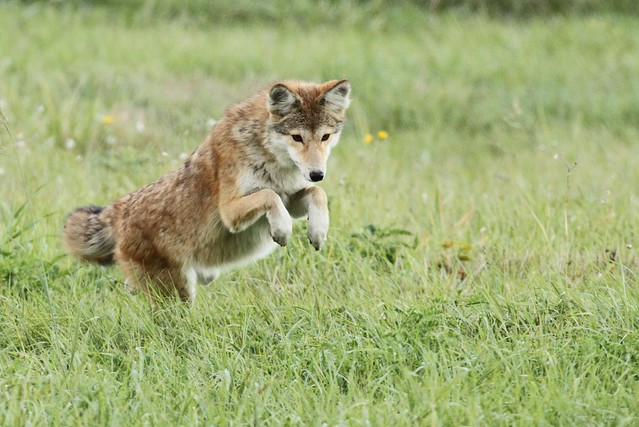
Coyote pouncing on prey at Fermilab, in Batavia Illinois.

Sunday, January 19, 2014

Owl Be Back!

The woods surrounding me had been silent for most of the time. The only things seen and heard up to this point were a Yellow-Rumped Warbler, a Northern Cardinal, a Dark-Eyed Junco and a flyover Cooper's Hawk. The howling winds just outside of the woods could not seem to touch me inside the stiff barricade of trees surrounding me in every direction. This was a welcome change from being out in the open. Black-Capped Chickadees sounded off in every direction, an American Goldfinch landed above my head and sang a very pretty little melody before taking off. A Hairy Woodpecker then made its presence known as it flew by, and American Robins flew over occasionally, making me wish that I could believe once again as I used to, that Spring came with the arrival of the Robin. Finally, in a tree, some movement. Directly above me some quick movements capture my attention! False alarm, a pair of Mourning Doves watched me as I made my way through a narrow path. Once again some excitement, as a ball of feathers sitting in a pine gives me hope of a Northern Saw-Whet Owl! Alas, with a better angle, it is only the puffed-up breast of yet another Mourning Dove. Darn! Lots going on in this patch, but one thing still missing. No Long-Eared Owls to be found. Over an hour of searching, and nothing to show for it.

Disappointed with that turnout, it was time to move on, and I, along with my partner in crime, my mom, made way to a new spot for us. This place, Hannaford Woods Forest Preserve, where a birding friend of mine had recent success of finding a Red-Headed Woodpecker, something I really wanted to get out of the way early on. It did not take long before stumbling upon a woodpecker, with a lot of red on it! However, it was a Red-Bellied Woodpecker, but one of the reddest ones I have ever seen!
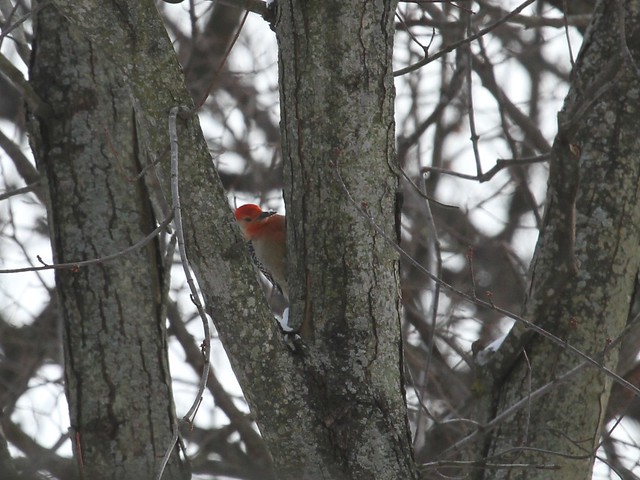
Red-Bellied Woodpecker


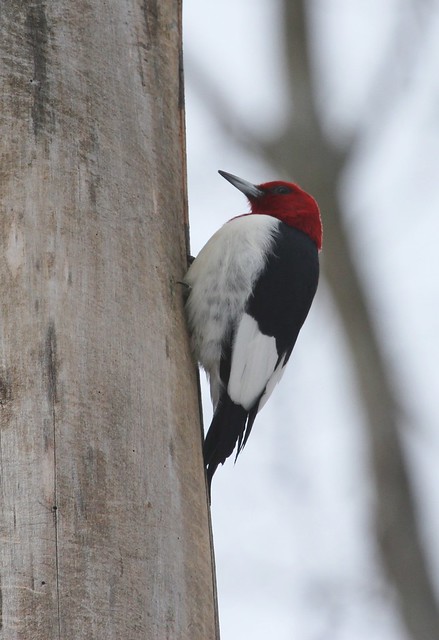
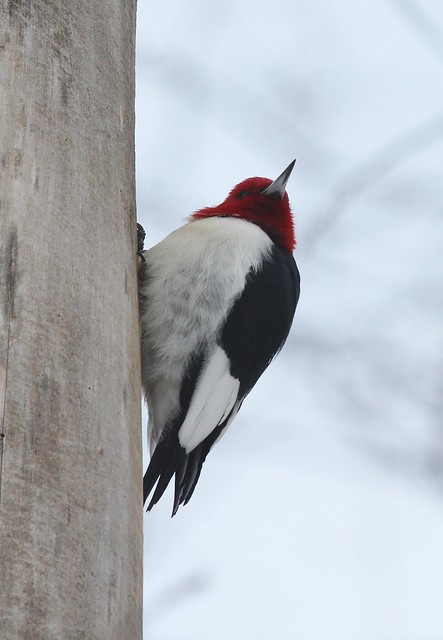
The search continues, and Dark-Eyed Juncos were scattering throughout the woods, vocal yet invisible. Going down the path further, another Red-Bellied Woodpecker showed up, but further still, a mysterious knocking. I scanned the trees in the area of the origin of the sound, and quickly found a black and white and red surprise, success! Red-Headed Woodpecker, one of my favorites! I had bagged a Northern Harrier for species #54 this past Friday, so this woodpecker was species #55!
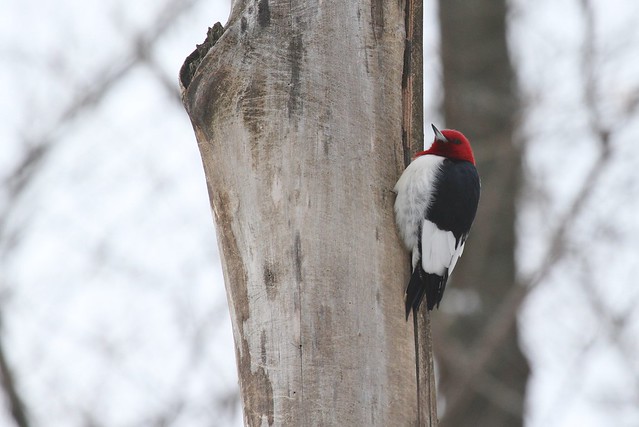
Red-Headed Woodpecker

Red-Headed Woodpecker

Red-Headed Woodpecker

Red-Headed Woodpecker

We watched it for a while, then turned to leave. Going down the path a familiar high-pitched call came from the treetops ahead. Not long after, a flock of Cedar Waxwings flushed up and took off overhead (#56)! I had heard them several times before this year, but decided not to count them as I had only heard them, and not seen them. Feels good to finally get that one over with!

We finally made it back to the truck, and my mom this time had a request of a place she would like to visit. So, we headed in the direction of Fabyan Forest Preserve, where I hoped that the Japanese Garden pines would attract my first Red-Breasted Nuthatch or Golden-Crowned Kinglet for the year. When we arrived, there was no hope already for any water birds. A very small strip of water was still unfrozen, but only a female Common Merganser could be found in this stretch of water (besides the Mallards and Canada Geese that are always present). The Japanese Gardens were not empty, but the Brown Creepers that were seemingly everywhere, were nothing new to me this year. A Red-Tailed Hawk decided to stop over and hunt here for a while, and gave great looks while doing so. Then I heard it, the potential of another year bird. A Northern Flicker was calling from the woods. I gave chase!

Scanning everywhere for the suddenly silent Flicker, I came up with nothing. This was very possibly due to the still present Red-Tailed Hawk. Keeping my eyes to the trees, I spied something that stopped me in my tracks! I whispered over to my mom "come here, but be quiet and don't make any sudden moves". She does just this, and follows my gaze and directions to find it herself.
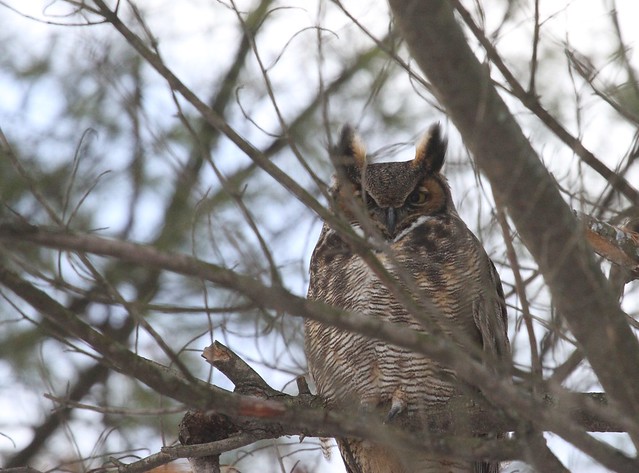
Great-Horned Owl

The owl was not flighty as they usually are, but I didn't want to take any chances. I made no noise, and moved slowly as I searched for a better angle to photograph it from. Here, I think I found one.
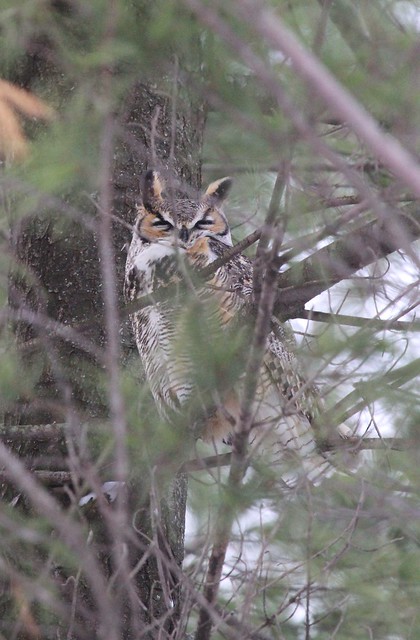
Great-Horned Owl

However, it turns out that this was a SECOND Great-Horned Owl that I spied from this different angle. So I made my way back over to the previous angle to snag one more shot of the first owl, which was probably the female judging by the size.
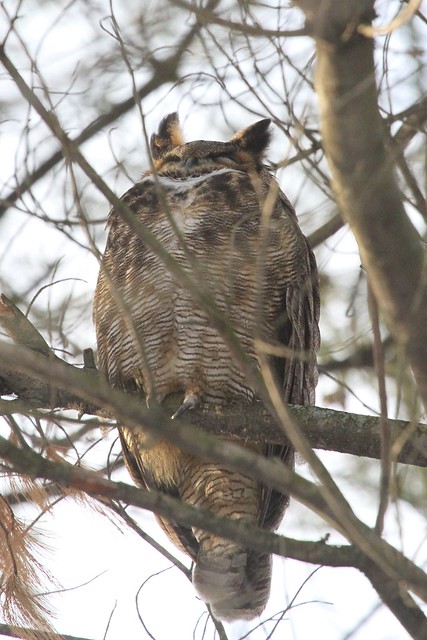
Great-Horned Owl

Not the owl I was looking for, but then again, I wasn't looking for an owl! This is where it sank in. "Darn, let that Flicker go too." Not a big deal, I'm sure I'll find one before too long.

At sunset, we ended up at the far north end of Nelson Lake, scouting out the potential for Short-Eared Owls. None showed, but I just might be back to check again. And that was that, another day in the books. With no luck today whatsoever with the owls I wanted, I know one thing for sure (please excuse this terrible pun), owl be back, soon!

Brendon Lake

Kane County Big Year- 56 species
Illinois- 56 Species

Thursday, January 16, 2014

Big Year Birding- Slow But Productive

Saturday was a pretty great day of birding, adding Harlequin Duck to my Kane County big year list. That was something I was NOT expecting to do at all. But, that same day I struck out once again on the Kane County Snowy Owl, which I had not been able to find since January 1st rolled around. So, early Sunday morning, I was back out at Dauberman Road, to search once again! Would this time be different? Possibly...

I had my mom doing the driving as I planned to scan the fields as we went, and I couldn't do that if I had to pay attention to the road. I also decided that the correct approach would be to pull over occasionally and step out of the truck to scan in great detail. The first time we did this, another couple of birders pulled up, it was Andrew A. again and Scott C. was accompanying him in the search for the Snowy Owl. They had already scanned the area well, but were planning on staying longer to keep trying to find the owl. I had not found it yet either, so we exchanged numbers and they went back out to Dauberman Road, while mom and I continued east on Scott Road after an unsuccessful original scan.

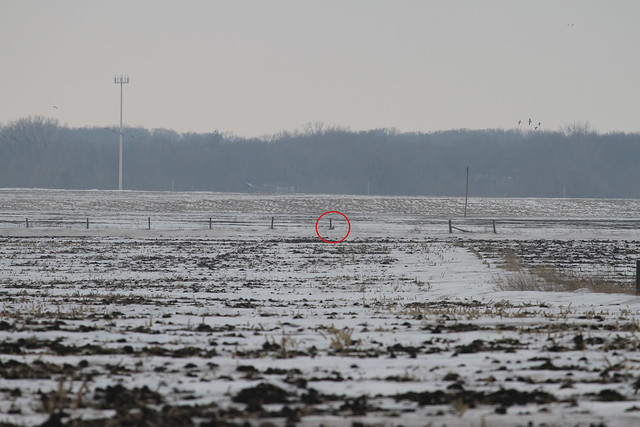
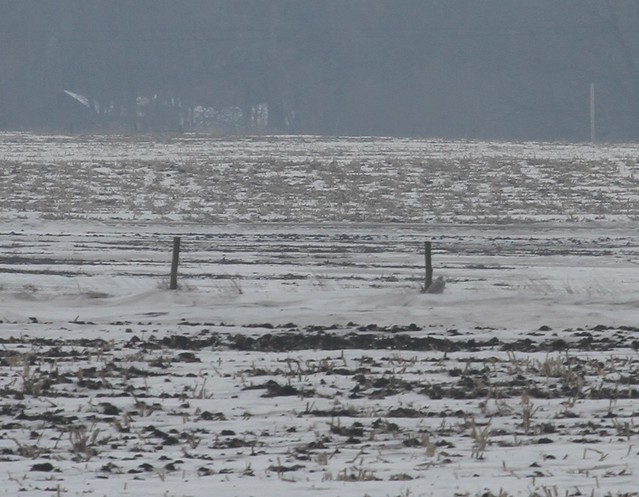
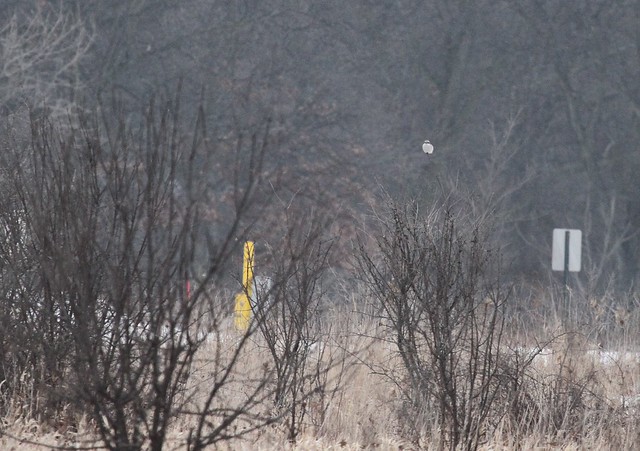
We pulled over just past a house on the south side of the road, and in front of a red barn on the north side of the road. Here I got out and once again scanned the fencerow that was out in the corn field about 300 yards away. Something out there seemed peculiar, so I stayed on it for another moment or two. What is that? It's a grayish lump... Next to a fencepost... Could it be? I pulled out my camera to take some distant photographs so I could zoom in on the viewfinder to pick up more detail. YES!! That grayish blob next to the fencepost was the owl!! Here are two shots, the first one shows how distant it was and where it was at, and the second is a heavily cropped, but still distant photo.

Way out there is where the Snowy Owl lies.

The Snowy Owl is to the right of the right fencepost.

Well, that took no time at all! Just a couple minutes after exchanging phone numbers, I happily called Andrew to let him know I had the owl. They pulled up five minutes later, and set up the scope. They had scanned this area for nearly 10 minutes earlier, but to no avail. Glad I could help!! These looks were very distant, which is frustrating for most, but it was enough to count Snowy Owl on my list (#49)!

Now the question was, where do I go from here? I hadn't made any plans to go anywhere else, as I thought I would have to dedicate nearly all my time to find this owl. But it took all of 40 minutes for driving, and another 10 minutes or so of scanning. So, from there I decided to take Main Street east into Batavia to check the Batavia Dam for a Great-Blue Heron and possibly some recently absent gull species. However, the gulls continued to elude me. It seems that for the past week, even Ring-Billed Gulls have been scarce on the Fox River.

When we first pulled up, I noticed a Bald Eagle in a dead tree along the river south of the dam, and then the waterfowl down below. Hoping desperately for a Bufflehead or an American Black Duck, I scanned every bit of the water there, and found no such thing. My scanning did not go without a reward however, as a female Red-Breasted Merganser caught my attention amongst a group of Common Mergansers! Here is a photo showing the Red-Breasted Merganser with a female Common Merganser. Note the differences.

Red-Breasted (front) and Common Mergansers

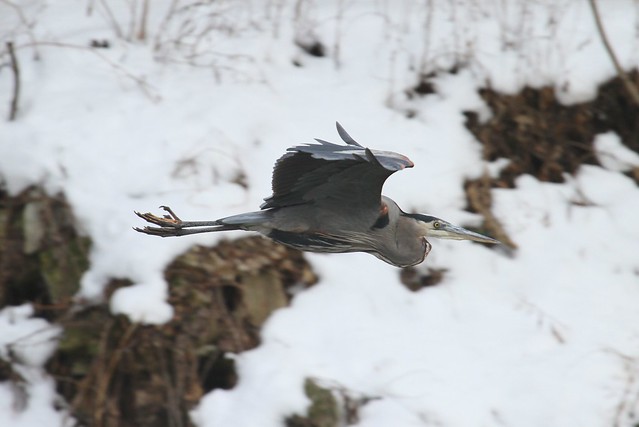
As you can see, Red-Breasted Mergansers are obviously smaller than Common Mergansers, and have no white on the chest and throat. Also, the female Red-Breasted Merganser's head is not as rich of a brown color. This is a good bird for Kane County, and now the second one I'd seen in two days! I felt good about that find, and walked the path to the dam to find the top completely frozen over. I turned back, and saw my mom trying to get my attention. She pointed at something, and I looked in time to notice a Great-Blue Heron flying up-river at eye-level (#50)! It then turned around and sat on a branch, then took off again and landed on the ice.

Great-Blue Heron Grabs my Attention

That was good, another target acquired! We ended up seeing another four Bald Eagles as well. After a quick stop at the McDonald's drive-thru, it was off to South Elgin, where I wanted to check the dam, and then go to Jon Duerr FP to try my hand at finding both species of Kinglets.

The dam was inactive, only Common Goldeneyes there, still no gulls to pick through. A few Bald Eagles again, but I decided to climb down from the berm and head back to the parking lot. I noticed someone walking our way, and I knew that I recognized this person. It was nice to see Vic B. out checking the dam for eagles no doubt! We had a short exchange, and I wondered how he had done looking for the Rough-Legged Hawks I had told him about. It sounded like he had some decent success and a very nice photo of one in flight proved that to be true later on that night! Always cool to see familiar faces while out and about!

From there, we went back south to walk back along the railroad tracks at Jon Duerr Forest Preserve. It felt weird knowing that this was the place a rarity had been since early November, and I WASN'T there to see it! The Townsend's Solitaire was one of the earliest birds on my list, and so I thought I wouldn't really even mind if it wasn't to be found. Walking back, another birder was coming from that direction, I asked just to see what his answer was. He had heard the bird, and the person who had gone before him had seen and heard it. He was also kind enough to give exact directions to the spot of the Kinglets. I walked back, slowly, just scanning everywhere and listening for the smallest of chips. Nothing, and I could see a couple of birders up ahead. I went up there to see if maybe they had found what they were looking for, and they hadn't yet.

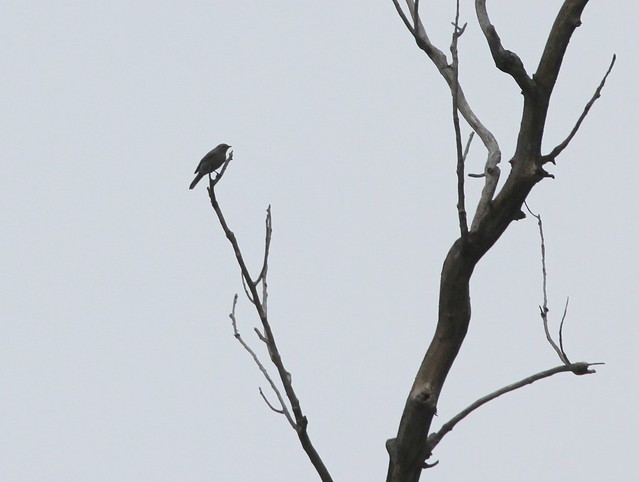
I caught their names, Sherman and Mary. Sherman I knew from the Illinois Birders' Forum. He wanted to see the Solitaire that day, so I told him exactly where I had seen it the last few times, and we walked in that direction a short ways, all the while exchanging stories and having a pleasant conversation about birds and photography. Suddenly, a bird popped up out of the Juniper grove, and into a tall dead tree quite a ways from where we were. The size, the shape, and the flight pattern all confirmed before I had even seen it in my binoculars, no doubt it was the Townsend's Solitaire! Here's a shot showing how bad viewing really was.

Townsend's Solitaire

Eventually, it flew directly over us and into some thick cover, not to be seen again by us. Sherman and Mary departed, excited by their success, and we continued on down the tracks, but failed to find Kinglets of any sort, although a Brown Creeper was a nice consolation (#51)!

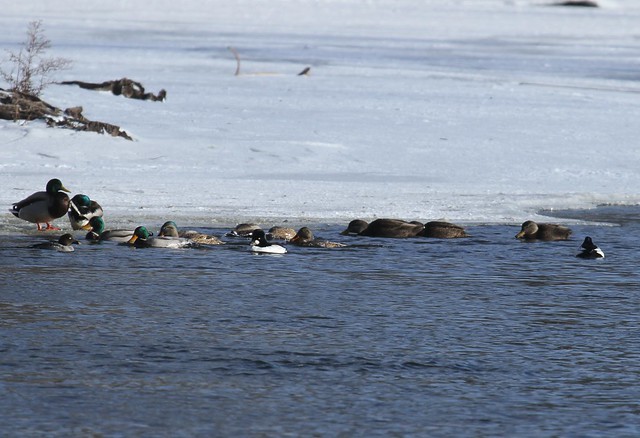
After Sunday, I only had a couple of somewhat limited windows to add some more birds to my list. I spent some time on Monday getting acquainted with a more local preserve, Hampshire Forest Preserve. I walked about 75% of the trails, and at least came up with a pair of Hairy Woodpeckers (#52). Wednesday I took an afternoon trip to the Fox River, up to the Carpentersville Dam where I came across 3 American Black Ducks (#53) amongst a bevvy of other ducks.

Three American Black Ducks (right) amongst Mallards and Common Goldeneyes.

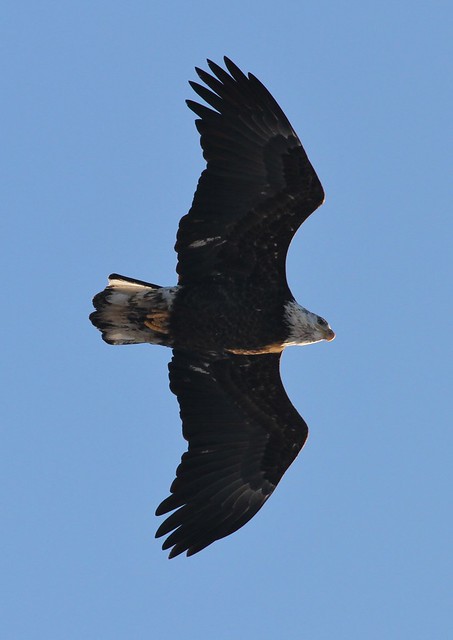
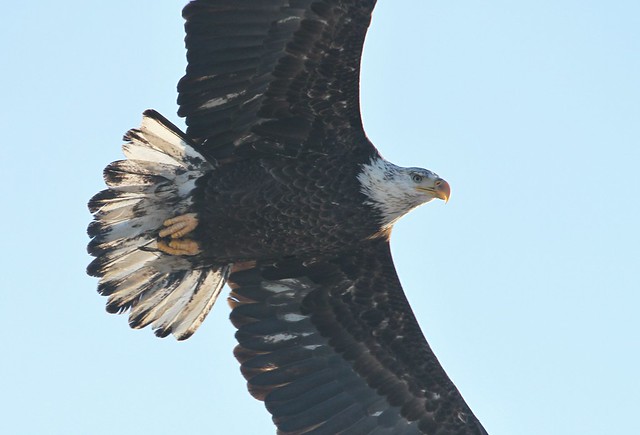
I decided then to check on another local rarity, a Harlequin Duck that had showed up in Elgin on the 11th. I was pleased to find it still there, but not so pleased that I had to look directly into the sun to check the rest of the river. I spoke to a fellow photographer, Jeff C. for a while, and watched as a Bald Eagle approached from the south. It passed by up at a reasonable height at first, but then circled back over the dam down lower. It was so close, I couldn't even fit it in the frame! Take a look for yourself, but the shots aren't the greatest, they are backlit.

Bald Eagle Passes Directly Overhead

Bald Eagle Flies Too Close!

And so we are now all caught up! I am currently at 53 species for my Kane County big year, and have 12 more to go to reach my goal of 65 for the month. The agenda calls for more owls and raptors, as well as some stubborn songbirds and wiley waterfowl, stay tuned!

Brendon Lake

Kane County Big Year- 53 Species
Illinois- 53 Species


Saturday, January 11, 2014

Clowning Around With Birds

The weekend looked great since early this week weather-wise, with temperatures predicted to be ABOVE freezing! Friday was the first day in eleven days that the temperatures did get back above 32 degrees in northern Illinois, and Saturday (today) was the second straight day of such pleasant weather for January. It was a much needed break, and a great opportunity to really do some big year birding! My original plan for the day: Search for the Snowy Owl near Sugar Grove, head north to get a Northern Shrike, then over to the Fox River to try for a Northern Pintail that had been spotted recently.

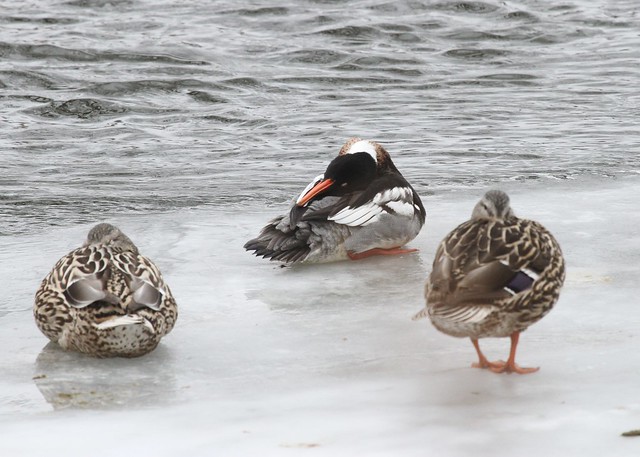
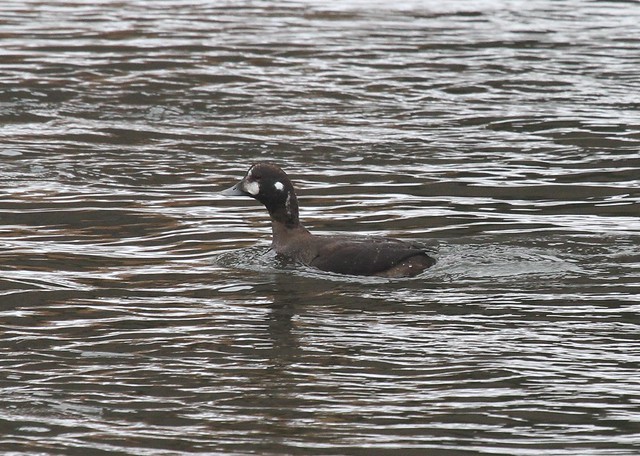
Those plans however, were very quick to change. An email from a fellow birder had me scrambling to get out the door and down to Walton Island in Elgin, as a very rare bird for inland Illinois, a Harlequin Duck, had been spotted there! This bird was a welcome rarity to add to my big year list for Kane County, so with my mom accompanying me, we headed down there as quickly as we could! The Snowy and the Shrike were going to have to wait (and I don't say that too often). When we arrived there, we could see other birders looking for (or perhaps following) said Harlequin Duck. We walked down along the river looking for it, but could not find it. That was when my mom grabbed my attention, asking me to look at a duck she saw hanging with the Mallards on the ice. This was a great surprise, a Red-Breasted Merganser drake (#40) was preening on the ice! This is another bird that is pretty uncommon on the Fox River.

Red-Breasted Merganser Drake Preening

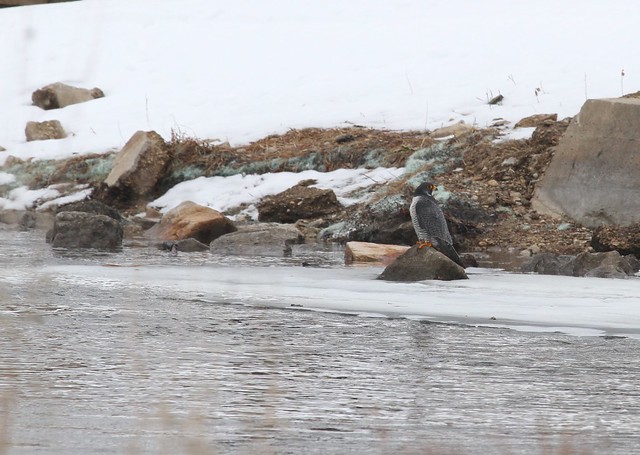
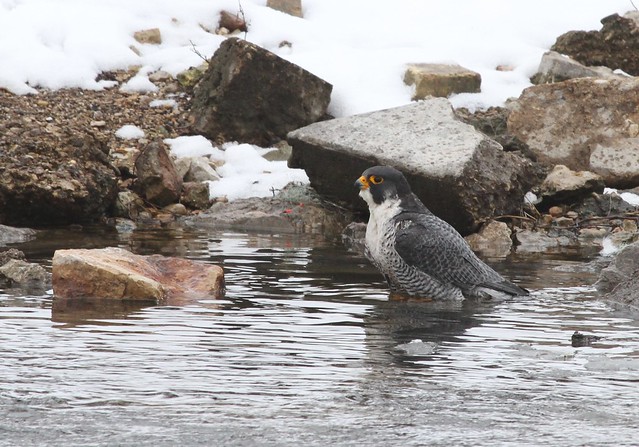
We continued on and crossed the river over to Walton Island via a footbridge, and found two birders watching and photographing something on the other side of the island. I approached and first saw a Belted Kingfisher (#41) flying north, then saw the Harlequin Duck (#42) in the water on the west side of the Island, with some Common Goldeneyes! As I walked up to get a better view, something flew in over my shoulder and landed along the east shoreline of the river, it was a Peregrine Falcon (#43)!

Peregrine Falcon Along the Fox River

With the Peregrine, I had seen all three of the expected falcon species for Kane County, in just 11 days! I wasn't really very confident that I would get either Merlin or Peregrine Falcon, so boy am I relieved! 

I kept walking north up the island, and found that I couldn't re-locate the Harlequin Duck. So, I then approached another group of birders (Andrew A., Bill K. and Dianne ?) and showed them the Peregrine. They didn't know it was there, so I was happy to point it out. They were also able to point out that the Harlequin had relocated to the east side while I was watching the falcon. Here I was able to get some better views and photos.

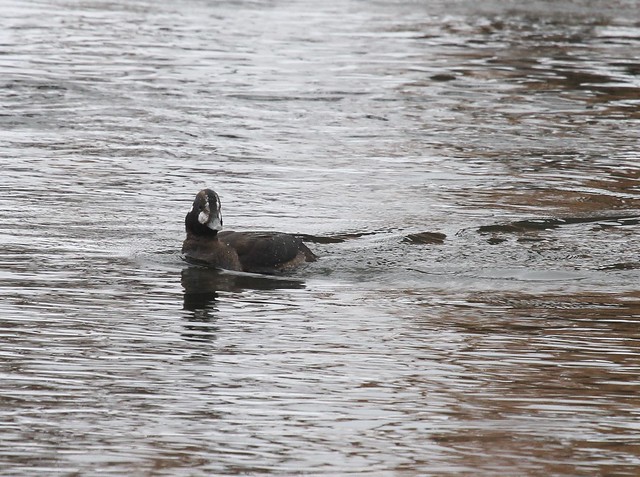
Harlequin Duck

Harlequin Duck

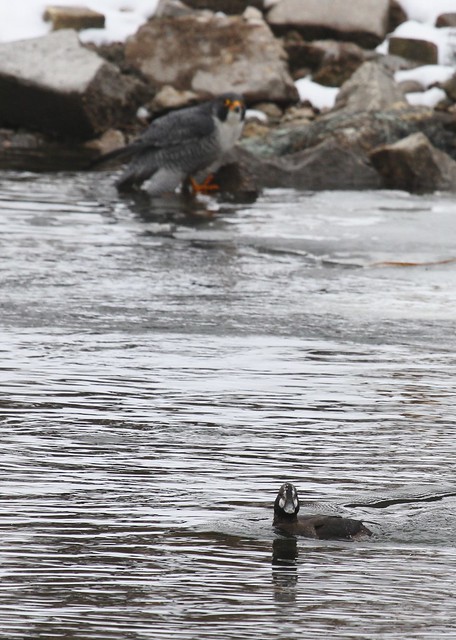
This next one is my favorite shot of the day, with the Harlequin Duck in the foreground, and the still present Peregrine in the background!

Harlequin Duck and Peregrine Falcon

The brown stripes on either side of the crown (most obvious in the first shot) and all the white on the face, along with a hint of green (1st shot) all point to this Harlequin Duck being a young male! 

And one more of the Peregrine!

Peregrine Falcon

I was glad to speak with Andrew A. and Bill K., especially since they were able to point me in the direction of a Pied-Billed Grebe (#44) that was tucked away amongst some shoreline boulders on the west side of the Fox River. After a while, this group of birders departed, and some new birders came in to enjoy this wonderful bird. I stayed for a total of a little over an hour, and then departed for South Elgin, where I hoped to have the same luck as I had here and to find the Northern Pintail. Unfortunately, these plans didn't go as well.

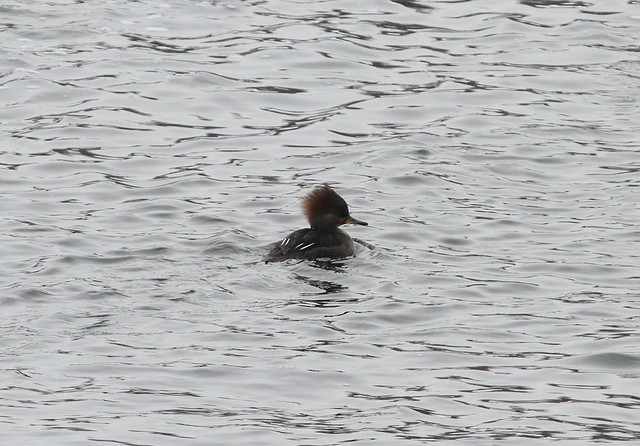
The South Elgin Dam had very little going for it, but it did provide new year birds in American Robins (#45) and Eastern Bluebirds (#46), and a female Hooded Merganser was hanging out with a crowd of Mallards just below the dam. Seba Park was no better, with the only new birds being about 5 Bald Eagles (two putting on a great show as they fished) and three Common Mergansers. The Common Mergansers helped me to complete the Kane Co. Merganser tri-fecta in one day! So with that, it was off to Dauberman Road now, to search for the elusive Kane Co. Snowy Owl!

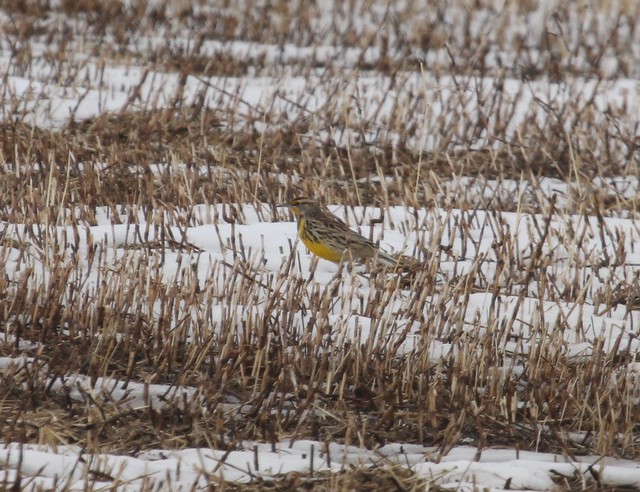
On the way down Dauberman, we found an immature dark-morph Rough-Legged Hawk feeding in a field on the west side. Luck was still not entirely on my side here either, as the Snowy went without being found by me or other birders looking for it. I will get this bird before January is over! However, a strange bit of flitting captured my mom's attention in a field on the north side of Scott Road near where it meets Dugan Road. She asked me to take a look, and what I found surprised me. It was an Eastern Meadowlark (#47)! That's a bird I don't usually get until March!

Eastern Meadowlark

And with that, it was getting to be late, but I wanted to go for one more bird, a Northern Shrike that I had been told about. So, we headed back north towards the Shrike location, and arrived there at quarter after 3. I walked the path I was told to walk, and scanned the area I was told to scan for a total of 2-3 minutes, when a small gray blob appeared at the top of a distant bush. Bingo, Northern Shrike (#48)!

Northern Shrike

And so, this ended my big day birding in Kane County, but I had one more bird I wanted to try for just outside of the county borders. It was 4:33 pm, when we came across a man with a scope pulled over to the side of a DeKalb County road. We pulled over, and I scanned the direction he was pointed in, and sure enough, there was the Snowy Owl! We watched it, and drew the attention of someone who lived nearby as she was leaving for church. She asked if we were alright, and we told her why we were pulled over. She couldn't believe what she was hearing, a Snowy Owl was out there! I asked if she wanted a quick look through my binoculars, and she pulled the car over and stepped out to get that look. She was delighted, and we were glad to answer any questions she had about it as well! I don't think there is a better way to end a day of birding than that!

Brendon Lake

Kane County Big Year- 48 Species
Illinois List- 49 Species


Thursday, January 9, 2014

Working Past the Weather

After an incredible cold spell along with plenty of snow and precipitation to make roads extremely difficult to travel safely, today was the first day that actually seemed as if it might be alright for a full day of birding. So, I decided to go for a few odds and ends, some that weren't guaranteed and some that had been seen recently. I also picked up a few surprises along the way! Staying inside of the Kane County lines, I was happy to have such a successful day! The weather forecast for the area I wanted to be at was 25 degrees with a 10% chance of precipitation. However, this winter 10% might as well be 100%, because yet again it was snowing nearly the entire time I was out.

I started on the backroads of Kane County, headed out of my little hometown of Burlington and heading South. The first few birds I saw were Horned Lark, along nearly every stretch of road. Next up was a dark-morph Rough-Legged Hawk on Peplow Road, that sat very close to the road in a tree, overlooking a corn field. I made it down to Meredith Road, where I carefully scanned surrounding fields, hoping the Snowy Owl I had found there a week and a half ago was still somewhere to be found. No luck, but a light-morph Rough-Legged Hawk hovered over a corn field on the west side of the road, a Red-Tailed Hawk sat near the Aqua Viva winery, and further down Meredith I added my first year bird of the day, Rock Pigeon (#33 after netting a Great-Horned Owl yesterday), of which there were at least 100 at the Elburn Co-op.

Further down to Dauberman Road, yet another Rough-Legged Hawk, a light-morph, flew to a farm past the road. My first destination was nearby, I wanted to find a Snowy Owl today, but a fairly thorough search (I still didn't see everything) came up empty in the vicinity of Dauberman, Scott and Wheeler Roads. More winter birds were along the roadsides here, but I did not see any definitive Snow Buntings. I decided to head back north to check a nearby spot for Eurasian Collared-Dove. I could not tell if there were any present, as I did not have time to scan through the doves that were visible, but I will be back again to check!

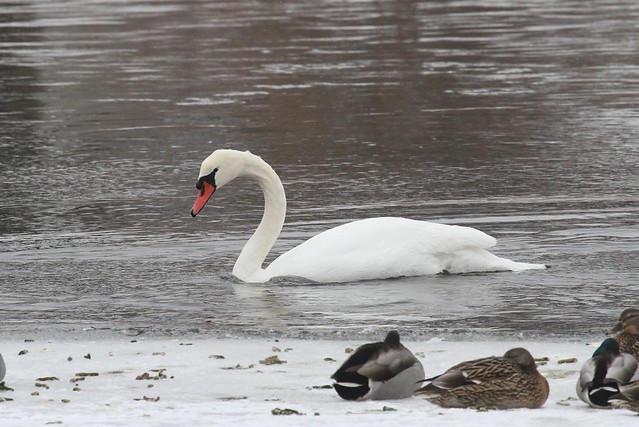
A little discouraged by a not so hot start, I headed further north, then east to the Fox River. Starting at the Geneva Dam to look for rare gulls, however I quickly saw it was a waste of time, as no gulls whatsoever were present! So onward I went up Route 31, to check the St. Charles area. Parking at Mt. Saint Mary Park and walking along the river, this area was much more fruitful. Plenty of Common Goldeneyes and Common Mergansers, Mallards and Canada Geese. Then, two very nice Mute Swans (#34) flipped back up to a more noticeable position, and allowed me to watch as they seemingly fed and preened in perfect synchronicity!

Mute Swan, one of two.

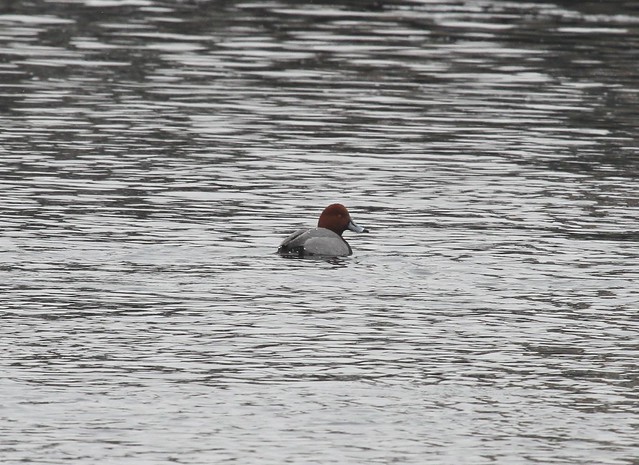
The next year bird was not far away, as four Song Sparrows (#35) fed along the walkway as I walked further north. The swans seemingly followed me as well. Another year bird was soon to be discovered, as I scanned the ducks and came away with a male Redhead (#36).

Redhead Drake.
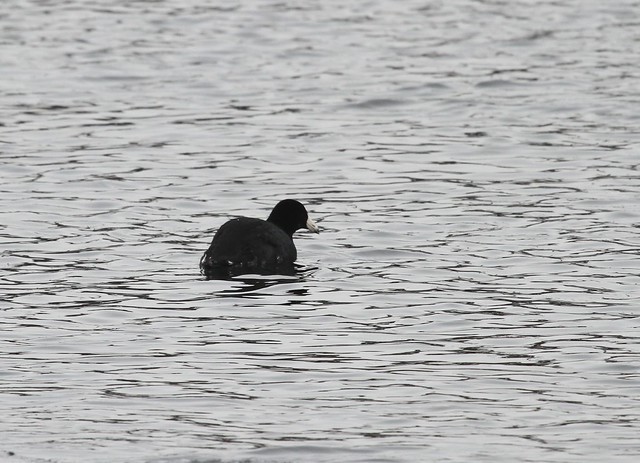
And another year bird was in the mix, an American Coot (#37)!

American Coot.
And no gulls, save for one Herring Gull, were here either. I headed further north to the South Elgin Dam, where I found my first three Bald Eagles of the day. The Common Goldeneyes were a little more cooperative than usual here, and hid a surprise with them as well, two Hooded Merganser females! (#38)

Common Goldeneye Drakes.
Hooded Merganser Hen.

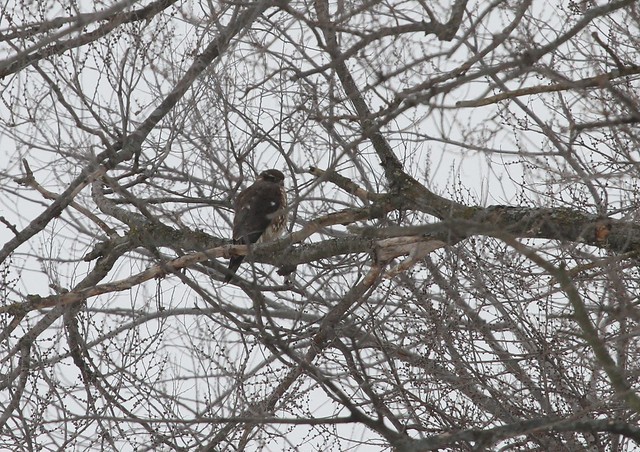
No gulls here either, so I got back into the car and drove to the south side of the bridge, and parked at Seba Park. First thing I noticed there was a dove-sized blob in a tree, but I knew right away what it was. A photo confirmed, a Merlin! (#39) The first one I had ever found on my own, and in Kane County.

Merlin

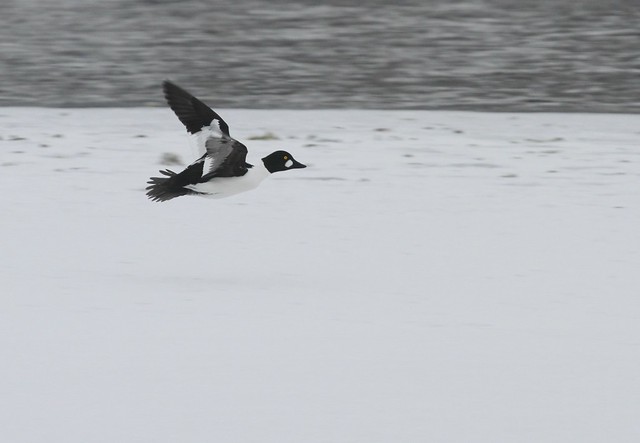
As much as I hated to, I had to walk away from the Merlin. And so I went along the river, finding all of the same birds I had seen along the river all day. Two Red-Bellied Woodpeckers and a few Bald Eagles gave me something to look at here and there. And the Common Goldeneyes were constantly flying up and down the river.

Common Goldeneye Drake in Flight.

When I returned to the spot where the Merlin was, it was nowhere to be found. A Herring Gull sat atop a street light over the bridge for what would be the last bird of the day for me. So all in all, a very productive day, adding seven new birds to my year list for a total of 39. Now, we will see what the weekend brings!

Brendon Lake

Kane County Big Year- 39 species.


Sunday, January 5, 2014

First Week In Action- Big Year 2014

I awaited its arrival for months seemingly, when I had only decided to run a big year in Kane County just about a month ago. Now, starting this past Wednesday, January 1st, the race was on! To clarify just what I mean by a big year in Kane County, a big year is a well-known challenge amongst the birding community, in which a person (or people) attempt to find the most bird species possible within a defined area, in a calendar year. My defined area is between the borders of Kane County, meaning that birds seen outside of Kane, will not count towards this attempt. There is a record for this, and to do this will require dedication, and a great amount of luck.
Well, to start, luck and the weather were not on my side. Wednesday was a harsh day in which snowfall and blowing snow made travel a risky proposition. And so, instead, I began my big year, watching hopefully for some spectacular birds to show at my back yard feeders. Not exactly what I had planned, but I netted 10 species feeder watching. Since the day was not going to get any better, I helped my mom do inventory at her work, where I was able to slide in one more species, a Northern Cardinal, by peeking out the window from time to time. Day two was sure to be better.... Right?
Right! The weather still wasn't near perfect, but I headed out a little before 8 in the morning, straight for South Elgin to stop first at the dam, and then at Jon Duerr Forest Preserve, where a long-staying rarity for Kane County, a Townsend's Solitaire, was my primary goal! The dam started pretty slowly, but I netted six new species there, including my first Bald Eagle. Jon Duerr was a fun time, even in driving snow and harsh wind gusts. Not a bird was to be heard while trudging through the snow along the train trolley tracks, following only one set of footprints that had been layed before my own.

Briefly, the wind died down long enough for me to be able to scan around for any activity. A quick fly-by by a Cooper's Hawk was a delight, but still no birdsong, not even a slight chip. I followed a trail for a small ways off of the tracks, where I heard the definitive "Chuck" note of a Yellow-Rumped Warbler, and soon after spotted it. The next bird flew over, and it could only have been one thing, the Townsend's Solitaire! It gave very good and definitive views in a nearby tree for a couple of minutes. Check!!! I scoured the rest of the preserve for nearly an additional hour, adding only a few species here and there to my year list. I came to edge of the Fox River, where a group of 98(!) Common Goldeneye was congregated under the bike bridge. Along the river, all was relatively still due to the trees blocking the wind. The only sound piercing this relative silence was a strange vocalization, which I later realized was the group of Common Goldeneyes! A strange, yet delightful sound somewhat reminiscent of an American Woodcock.

Next stop off was the Geneva Dam, and Island Park in Geneva. Here, I netted Common Merganser and American Crow, but no unusual gull species like I had hoped. From there, I thought it wise to go check two rural locations known to have been where Snowy Owls were found recently. I struck out on that search as well. My only two consolation prizes were a hunting American Kestrel on Dauberman Road south of Kaneville, and an adult dark-morph Rough-Legged Hawk roadside on Peplow Road south of Burlington. I ended that day with 18 new species, for a total of 29 for the year.

Weather conditions kept deteriorating through Friday and into Saturday, making travel on Friday impossible, and Saturday not worth much of anything with one new species added in a roadside Red-Tailed Hawk. Today (Sunday), one more species was added to the list when a group of Brown-Headed Cowbirds attended the back yard feeders. I finish my first partial week of my big year at a very modest 31 species seen. As for the upcoming week, it doesn't get any better weather-wise until possibly Thursday. But tonight on into Tuesday, wind chills are supposed to bring the temperature down to a feels like of -30 to -50 degrees F!

Keep checking back here for new reports as my big year progresses! As you may have noticed, no photos were included, and that was because I did not take my camera out in these ridiculous weather conditions. We'll see where it goes from here, but something's gotta give with this Illinois winter weather!

Brendon Lake

Tuesday, December 31, 2013

Year in Review- My Top 10 Nature Shots of 2013

The day is finally here, and we are now just less than 24 hours away from the end of 2013. 2013 was a very good year filled with great nature photos, fun times and awesome stories! Right about this time, many people really reflect on the things that happened for them or to them in the past 364 days, and I thought I would do the same. Here in this post, you will see my 10 favorite nature photos that I took this year, and also the reasons why they rank where they do. Photographers always treasure the shots they are able to get, especially when there is a great story behind the capture. Having a story to go along with the photo makes it that much more special to the photographer and those enjoying the work. Please enjoy the following post!

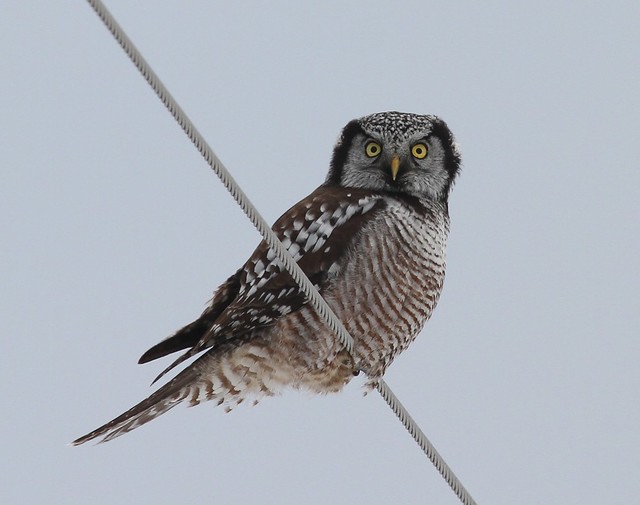
#10- Northern Hawk-Owl
Starting off the countdown strong here, with a creature that is not commonly seen, and is always a treat to see. It seems like it couldn't have been this year that I took this photo, and, if all had gone according to plan originally, it wouldn't have been taken this past January! I trekked up to where this owl had been seen in Door County WI in mid to late December of 2012. However, I failed to find it, and found out on the way back down (5 and a half hour trip each way) that my directions were bad! If I had gone just about a mile further north, I would have found it! Drat!

That really stung, so two weeks later, I once again made the trip up there, this time to the right spot. And as you can see, the results were much better!! The fact that I failed miserably due to my own mistake the first time made this photo all the more enjoyable. I was also able to get some video of it. The reason why this ranks as number 10, is because of a few factors. One, it is a rather dark photo, due to poor lighting conditions. Two, it is sitting on a man-made perch, being a power line. But still, the story and the bird make this shot worthy of my top 10 for the year! The video I captured of it is included below.


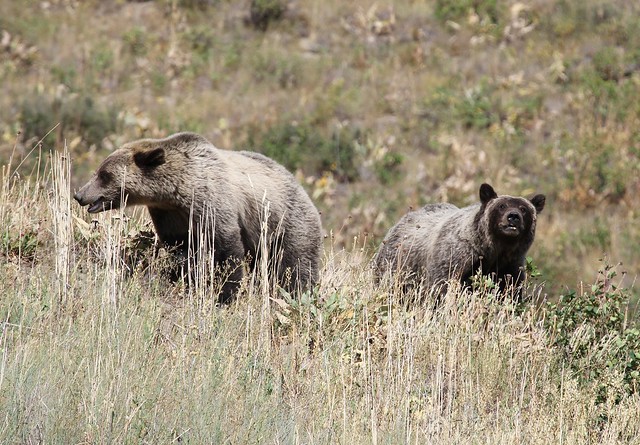
#9- Grizzly Bears
A trip to Wyoming was a major highlight of my year this year. I wanted to see Grizzlies, and was planning on Yellowstone National Park. Unfortunately, wildfires abounded in Yellowstone at the time we were there, so instead we stuck to Grand Teton National Park. The bears were plenty active in this area anyways! The night before, three Grizzly Bears were up high on the mountainside over the roadway that we took to go back to our lodge. The next day, we saw two just a tenth of a mile away from where they were the last time.

These two were way up there, so I asked my mom to pull the car over so we could watch them. One of them took off at full speed down the mountainside, headed almost directly toward us! While my mom had a panic attack, I wanted to see where this was going, and there was still plenty of time to react. So, standing behind the vehicle and shooting over the top of it, I proceeded to watch as what appeared to be playfulness between two Grizzlies brought them to within 150 feet of us. They stopped near a patch of bushes and trees, and then slowly ambled off along the mountainside, when I captured this shot. That moment of excitement and the fact that my heart wouldn't stop pounding until about an hour later, make this somewhat average sharpness photograph #9 on my top 10 list!

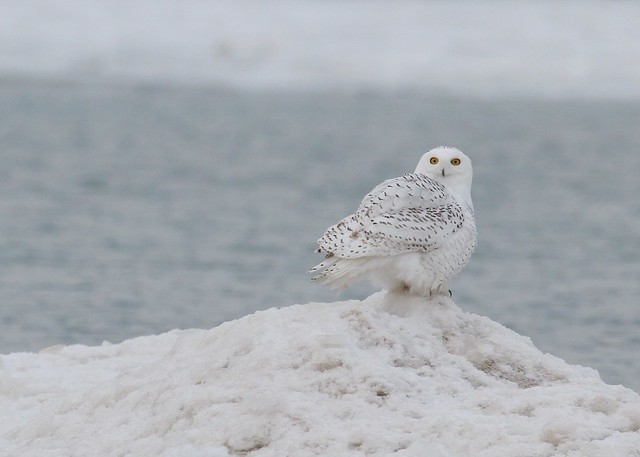
#8- Snowy Owl
This photo is the most recent, being taken earlier this very month! Snowy Owls are birds of the high arctic, in the summer. In the winter, depending on the availability of prey in the arctic, they will move south in varying degrees. The more food available up north, the less likely they are to come far south. This year is one that is known as an irruption, or heavy southward movement of owls that are looking for a food supply that is able to sustain them through the winter, and plenty of owls have made it as far south as Illinois already, such as this one which showed up in Chicago!

I have seen and photographed Snowy Owls before, but I was really hoping to get some more images, especially since opportunities were everywhere. As many as four to five Snowy Owls had been seen in days prior to my trip into Chicago, at Montrose Harbor. As soon as I arrived at the beach, a couple of great photographers and friends showed me four that were at the moment, seeking refuge on and under the pier. The one under the pier was there because it had been through a traumatic experience with a rival predator, a Peregrine Falcon. The falcon had dove at the owl while it was out on the beach. Peregrines have the ability to dive at about 200 miles per hour, so it would be very intimidating to have that occur. The owl flew under the pier for protection after the attack, and stayed there for quite a while. This was what had happened before I arrived, and why I saw the owl sitting under the pier, which I thought to be unusual.

I normally shoot with a lens that has a maximum reach of 400mm, which with my crop censor camera body (Canon 7D), has an equivalent to 640mm on a full-frame camera (say, a Canon 5D Mark III). This was not enough reach however, but a very generous friend allowed me to use his 600mm setup while he took care of some business. If it weren't for that kindness, this shot would have been unachievable. Among the four owls, one was the most active, and I spent a lot of time photographing it in flight as it hunted ducks out on Lake Michigan. It was unsuccessful in its hunting. But, as it got closer to sunset, the one under the pier decided to join the party, and emerged from its haven and landed out on a pile of ice. That was how I got the shot seen above.

Now, as an important message, yes these owls are enjoyable to view and photograph. And yes, they are currently scattered throughout our area, but take great care and caution if you do view one. I kept a respectable distance (never get closer than 50 meters), and never approached the birds. It is important to keep back, so they aren't stressed, as stress can help disease and starvation progress. DO NOT use flash if you photograph an owl, and DO NOT force it to fly. I was only this close because the owl flew towards me. It is a matter of life and death! This owl was difficult to capture in tough lighting, but this shot easily deserves #8!

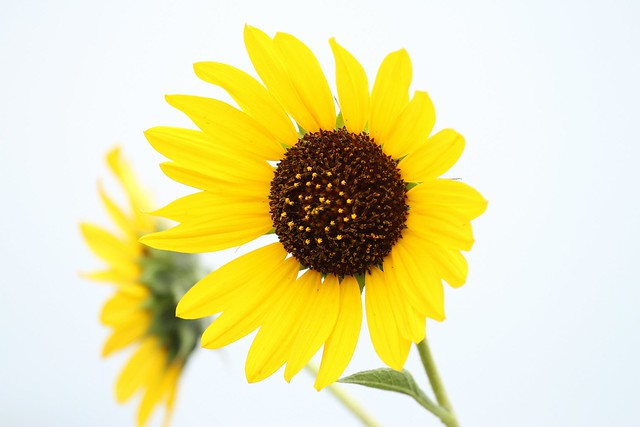
#7- Sunflower
Now, after a long story, it's nice to have a short and simple one. This sunflower was taken in Nebraska, on my way to Wyoming. Plain and simple, I love the isolation my settings created by making a pure white background out of an overcast sky. The color is vibrant and really pops! Plus, the focus in the center is exceptional if I do say so myself, and that is why a simple sunflower makes #7 on my list. A simple subject, but a great shot technically speaking! More flashy things are yet to come as you read on!

#6- Coyote
This coyote made for a great photo opportunity as it hunted for its next meal at my favorite place to find coyotes, Fermilab in Batavia IL! Here, the coyote is pouncing on a rodent that it heard in the grasses nearby. I always wanted to capture an action shot like this, and this is my first time being successful! This shot deserves the #6 spot on my list, because of its composition, the action that it captures, and because coyotes are beautiful animals! That is, as long as they keep away from my dog!

Alright, now we are on to the top five!! Thanks for sticking with it this long, I hope you continue along!!

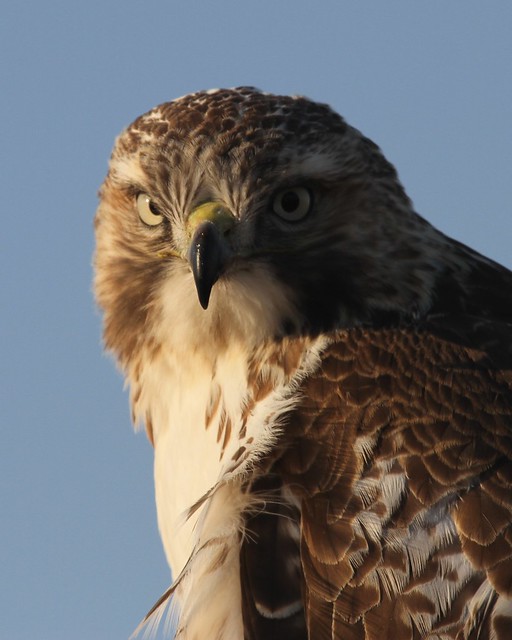
#5- Red-Tailed Hawk
This dramatic capture was taken at Northerly Island in Chicago. Here, I found an obliging young Red-Tailed Hawk and proceeded to tail it as it hunted for prey. The bird surprised me by flying and landing atop a chain link fence within six feet of me after finishing a meal! That is how I was able to get this full-frame portrait. This hawk made for a couple of hours of enjoyable viewing, and made my day, along with several others. The full story can be found here.

http://www.ilbirds.com/index.php?topic=52325.msg83543#msg83543

The lighting's dramatic contrast in this image, along with the great clarity and detail present in the feathers and face, make this image one of my favorites of all time! But, I feel I still captured some better shots. So the countdown continues with #4!


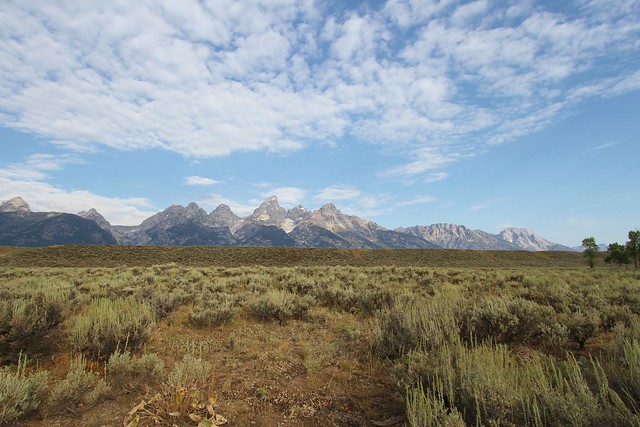
#4- Grand Tetons Mountain-scape
Wyoming is a very scenic place, and the Tetons are especially so. Glorious mountain peaks are visible so long as the sky is clear anywhere in Grand Teton National Park, but I found River Road, a road that goes along a river valley, to be a particularly special view. This photo was taken in a valley filled with sagebrush habitat, and that is why you can see the hills in front of the mountains. At the top of those hills is where the main highway is, but I was down on a road that required 4-wheel drive in order to take it.

Early morning light that was subdued due to light cloud cover gave this image a very special lighting effect, by softening the light the clouds acted as a diffuser would on a flash. There was an even light on the entire landscape, except for towards the top of the mountains. Even when it was cloudy, the peaks of the mountains sometimes were lit by the sun. This was my favorite landscape shot taken during my trip, and since it reminds me of a great trip every time I see it, it makes #4 on my list!

#3- Great-Horned Owlet
I had the pleasure of being able to watch a Great-Horned Owl nest from the laying of the eggs, all the way through to the fledging of the one owlet. This shot was taken the very first day the youngster was discovered to have left the nest. It was flapping its wings wildly at times, as well as constantly turning around on the limb. The time I was able to spend watching this owl family was enjoyable.

Owlets have something that make them some of the most irresistible things to see in the world. In fact, grown owls are the same. Why is this? It may be because they can sometimes resemble people. Most birds have their eyes on the sides of their heads, but owls, like people, have eyes that face forward. This gives them a human-like impression in my opinion. And so, when we see young owls, we often think of children.

For that reason, and because this moment was spectacular and unforgettable, along with coming away with a great image, this photo is #3!


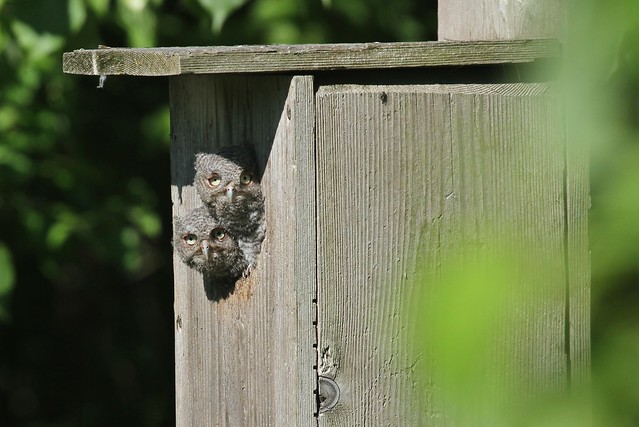
#2- Eastern Screech Owlets
This shot is special to me, because getting to see these beautiful birds is how I came to meet some incredible people, and also how I have spent some incredible days. For the past few years now, I have watched as a pair of Eastern Screech Owls has successfully raised broods of owlets. This year, they raised four healthy owlets, and here are two pictured peeking from the nest box. Unfortunately, I am not too sure I will have the opportunity to continue watching this family come this year and years beyond.

The lighting is possibly the best I have ever encountered while watching these birds, and the pose is just stunning to me. I love this scene overall and the possibility of it being my last capture of these birds ever makes this photo #2 on my list.

#1- Black-and-White Warbler
Yes my number one is really a tiny little bird! I am incredibly proud of this capture due to the difficulty of capturing one of these little birds in action. This photo is the greatest example of spot-on timing I have ever achieved as a photographer! I chose a spot to focus on, on a nearby branch, and when the bird came around to my side of the tree, it was dead center, and I hit the trigger! Success!! Black-and-White Warblers, and warblers in general, are VERY difficult to capture well because of their size and speed. That is why this shot is my #1 shot of 2013, taken in Lincoln Park Chicago Illinois!

That's the countdown, I hope you enjoyed everything I had put here! More to come from me on this blog come the new year, and hopefully many more photos that will entertain and fascinate you!!

Brendon Lake


Monday, December 2, 2013

The Lake View On: Making A Bird Photo "Stand Out"

As a wildlife photographer I come across fellow photographers everywhere I go. It is a very common hobby, and for some a living or a passion. I find that, especially with bird photos, there is a lot of overlap. Common bird species are photographed daily, so there are droves of photographs of them out there. Now, with everyone being connected through modern technology, it doesn't take long for rare birds to draw crowds either. So, with all of these photographs competing with your own, how do you draw attention to your work over others? How do you stand out? Well, I'm going to do my best to answer that here.

First and foremost, since the subject will no longer matter in terms of how good or how rare of a photo it is because of this "saturation" of photographs, how you photograph the subject is going to be the most important aspect. Composition will be the key. What kind of substance can you give to your photograph that other people may not have the vision or ability to do? There are several different ways to achieve strong composition. My favorites, or the ones that I most commonly use, are what I will be talking about.

The first thing I look for in a scene is directionality. Is there a certain point that will draw attention to itself, other than the subject? If so, then accentuate it. Now, when I say directionality, I am talking about the general flow of direction. Be it the way the bird's facing, how its body is positioned, or patterns in the background that draw attention, use those to your advantage. This will often go hand in hand with a generalization that I like to call "the rule of thirds", which is something I normally use in post-production rather than the original process of taking the photograph.

"The rule of thirds" is my way of saying framing is important. Now, with one of my computer's editing programs, My crop box has sections that make it easy to determine my subject positioning. The rule of thirds is aligning your subject in one of three sections either vertically or horizontally in the photograph. I also like to say it is being "appropriately sloppy". Basically, people are always told a photograph is best when the subject is centered in the photo. That is not always the case. Now, this always works best when there is a certain flow of direction in the photo. Here is an example.


In this photo of an Eastern Phoebe, a relatively common and drab bird, the overall direction of the photo makes you look from left to right. This is partially due to the direction of the bird's gaze, but also partially due to the contours of the branch it is perched on. The bird is placed slightly into the left-hand third of the photo, and this brings a certain sense of balance to this photo because something is in good focus all the way across the frame from left to right. I hope you agree that it adds a certain effect that makes it look better than if the bird were directly in the middle of the photo.

The above photo also makes good use of scenery. The branch is just as much a part of the photo as the bird itself. Ask yourself this: What is around the desired subject that may add to the photo? The answer could be plants in the background, the tree the bird is sitting in, or possibly other animals around the bird. A photo immediately becomes better if more than one of any subject is present, and in good focus. Try to include something either on the same plane of focus as the subject, or in the background, it's better than just the subject and nothing else. Here is another example.


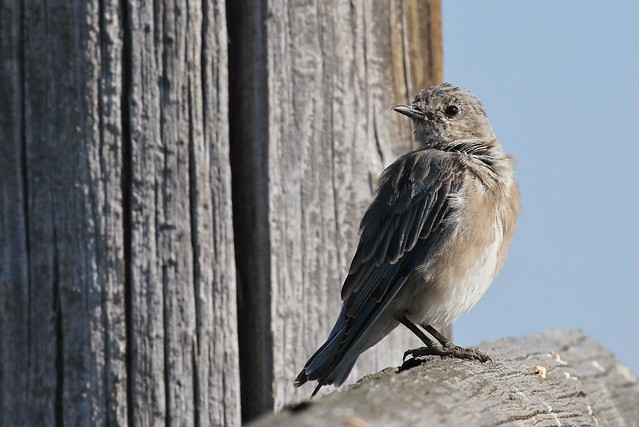
Here, we have a young Mountain Bluebird sitting on an old wooden fence. Using the post as the background instead of just a bunch of blue sky, added an element of depth and more detail to the scene.

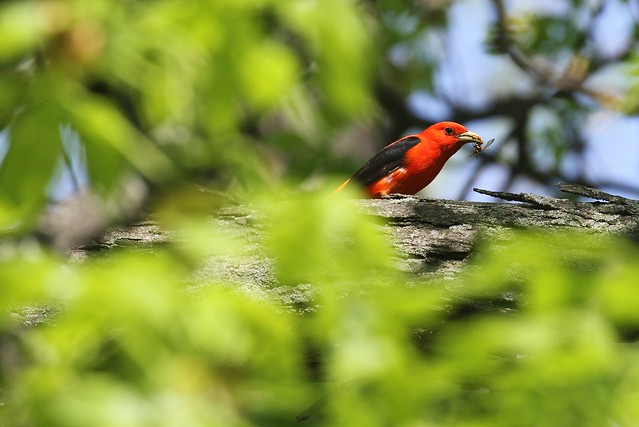
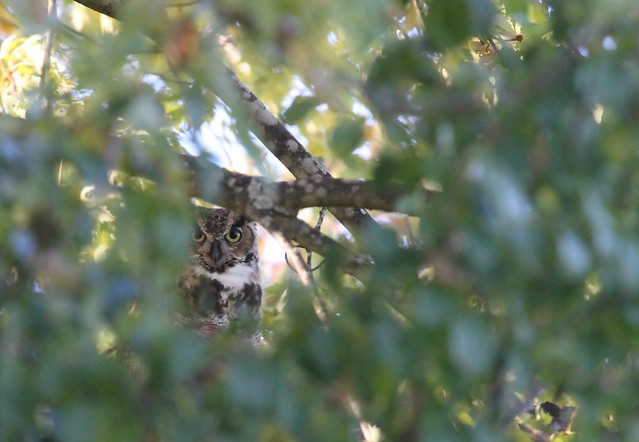
Now, there are times when scenery can be a disadvantage too. The best you can do in these situations, is try to turn a negative into a positive. Try to use that scenery to accentuate your subject. Bird photographers know the frustration of seeing their subject in the middle of a dense bush or leafy tree all too well. But, when life gives you lemons, you're supposed to make lemonade, no matter how sour those lemons may be. Here are a couple of examples.


These two photos show clutter in the foreground, but the clutter gives a framing effect. This helps to draw your attention to the subject even more. Mmmmm, that's good lemonade, it just took a little bit of sugar (or a positive outlook as the case may be).

Now then, while a bird sitting nicely is never going to be something I will complain about, sometimes a little bit of action makes the shot that much better. If you can catch some action that others may have missed, then your photograph immediately becomes more attractive. This will require patience and timing. Stick with a subject as long as you can, something will probably come out of it. I learned this the hard way, watching a White-Tailed Kite that was far off in the distance. I decided to call it quits, and found out later that 10 minutes after I had left, the Kite flew directly over where all the photographers were standing, including where I was. Darn!

Timing is also important. Watch the bird for behavioral patterns, something that tells you what its next move will be. If you can predict its next move, you have a better chance of getting that action shot. Always have your camera at the ready, using a tripod can help with this. Think about this when viewing the next two photos: Which of these do I think is better?


Each of these photos are good in their own ways, but considering the second photo captured a moment of action, forever frozen now in a photograph, that one will widely be considered better.

Two other things can really add to a photo. Angles will help a photograph, especially when photographing shorebirds and waterfowl. Lower angles will be more appealing. So the next time you can, lay down on that boat, or kneel on that beach. Get low and try it!


Lighting is the other thing, be careful of when you are shooting, or where you are shooting. Photos that are too bright lose detail, sharpness and color. Try shooting early in the morning on sunny days, or late in the afternoon. These are called the "golden hours" because they give photographs taken in these times warm golden glows. This adds to color, and makes the images more inviting. However, you can't always shoot just in these times, so get out there and experiment, shoot at all times!


Now I know this post has been a long one, so thanks for sticking with it until the end. The last thing that will make your bird photos stand out above others is... QUALITY! Strive for the cleanest, sharpest image you can get! It makes all the difference. Thanks for reading, and I hope you find this to be helpful!!

Brendon Lake